I don’t do paid commissions.
Sketch Chemistry was different. I had a freelance contract with the American Chemical Society for Sketch Chemistry, which had to be cleared by my day job. Every year I had to get approvals and fill out a conflict of interest management plan. Other freelancing offers are just too laborious to manage – the process would make it less fun.
My approach to dealing with offers to collaborate is to do it as community service. This allows me to be selective, control expectations, and to make sure everyone enjoys the experience. My selection criteria are simple:
- the person asking to collaborate must be a good online citizen
- the project must be interesting (i.e. fun!)
- the timing has to be right
On 12 July 2020, I was contacted out of left field by Phil Baran (Scripps). He asked if I had some interest in producing coverart for his group’s perspective on Taxol (paclitaxel) synthesis. The work was to be published in the Journal of Organic Chemistry. He said he was willing to pay.
I had interacted a lot with the Baran group on Twitter. Mostly poking fun at the level of detail in their supporting information. Oh, and their partnership with IKA. Not to mention their strained ring openings, borylations … quite a lot actually. So, good online citizen? Check!
The project was definitely interesting. The pursuit for the first total synthesis of paclitaxel was a big deal in my final undergrad year. The Nicoloau and Holton race even made it into Encyclopedia Britannica’s Science Yearbook back in the day. Second point? Check!
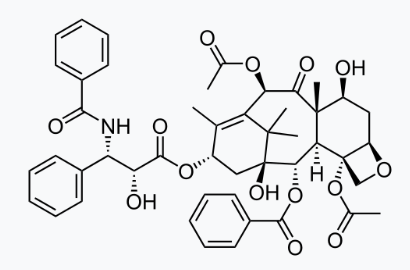
The timing? It was the 12th July. The final image was needed by 17th July. I was in the process of packing to move house, so I had a couple of days off work. The move date? 17th July! Tough timeline, busy packing, arranging a move through COVID – sounded crazy enough to be fun. Third point? Check!
The time difference between San Diego and Singapore was just right. We could communicate live at a reasonable time of day for both of us. I wrote back to Phil and said I would do it, but couldn’t accept payment. He insisted, but so did I. I also encouraged him and his group to work on something of their own, just in case I couldn’t meet expectation or make the deadline.
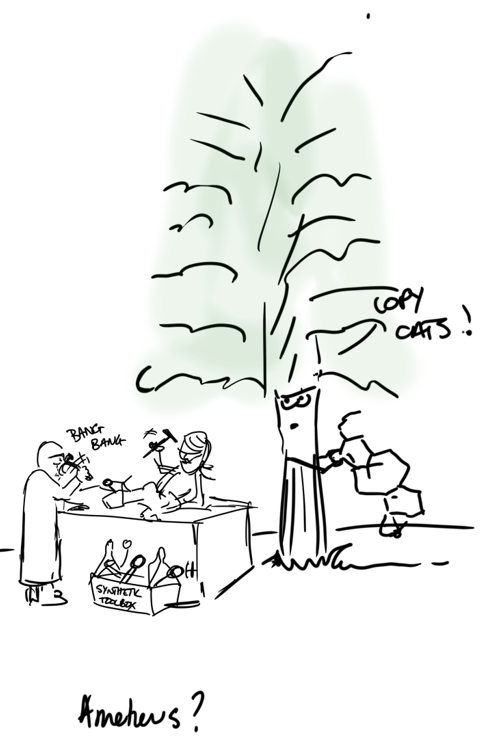
Phil came with an idea already formed. In nature, paclitaxel comes from the bark of the pacific yew tree. He suggested that a yew tree could be looking at some people making it in the lab using a “synthetic tool box”, rolling its eyes and saying “Copy cats!”.
In about five minutes I sketched the image below and sent it back to him. You can see my suggestion of the word “Amateurs” on the sketch. The toolbox was deliberately hammers, to make it look somewhat primitive next to the tree. Instead of eye rolling from the tree, I tried to show it was indignant. Phil was sold, and away we went.
Phil’s postdoc and lead author on the paper (Yuzuru Kanda) helped drive the work. Again, the time difference meant that feedback was fast. By July 14th we had the final product as it appeared on the cover below.
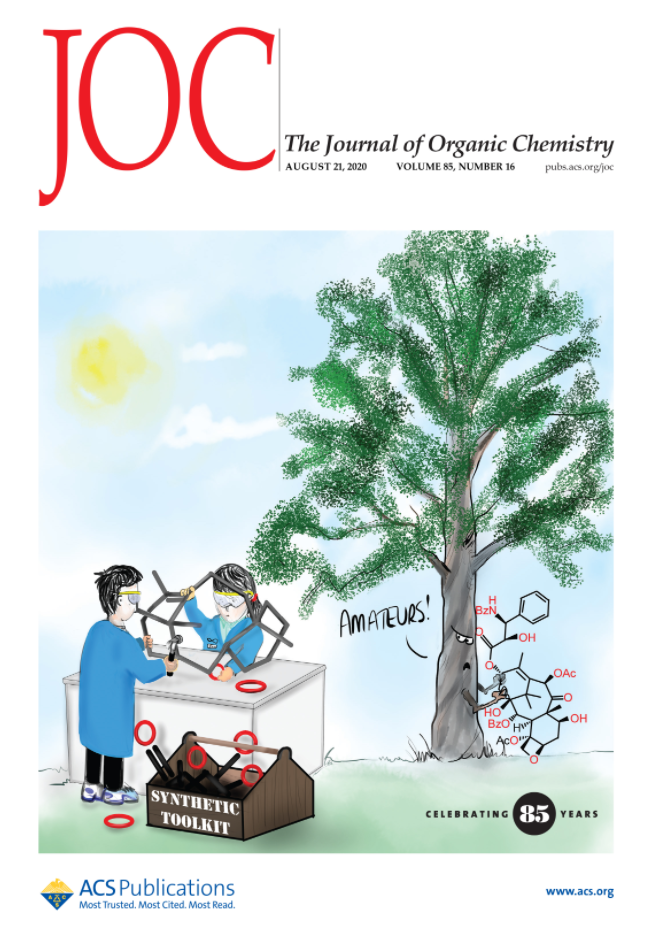
We crushed the deadline. The excitement and the energy Phil and Yuzuru had for this project was infectious. I certainly had a great time. The interaction was short, sharp and we were all razor focused on the outcome. The fact Phil provided the initial idea meant we got on the same page very quickly. The cover was very well received. It was a great experience all round and remains one of my favourite collaborations.
Phil was generous enough to buy copies of the ChemScrapes book for his group. That was very kind of him. That gesture basically accounts for nearly half the copies ever sold before I took the book out of print.
There is definitely more to life than money.
 ChemScrapes
Leave a comment