I was an academic for nearly four years in New Zealand.
I taught all levels of organic chem, from first year introductory organic chemistry, to postgraduate courses on solid phase organic synthesis. I loved every minute of it and I really hope it showed for those who sat through my classes. Enjoying teaching doesn’t mean it’s easy though. I found first year chemistry particularly challenging.
The first year class was typified by a wide distribution of abilities and interest. The challenge? How to keep the top of the class entertained while trying to motivate those who were just filling in degree points to do well? I used a combination of overhead transparencies, PowerPoint and blackboards for my lectures. This was to make sure I was mobile in the room. I tended to stand in the aisles and looking at the screen (for PowerPoint) from the students’ perspective. When someone asked a question or tried to answer a question I had asked, I would approach that person and try to make sure the class could hear. I thought I was the bees knees.
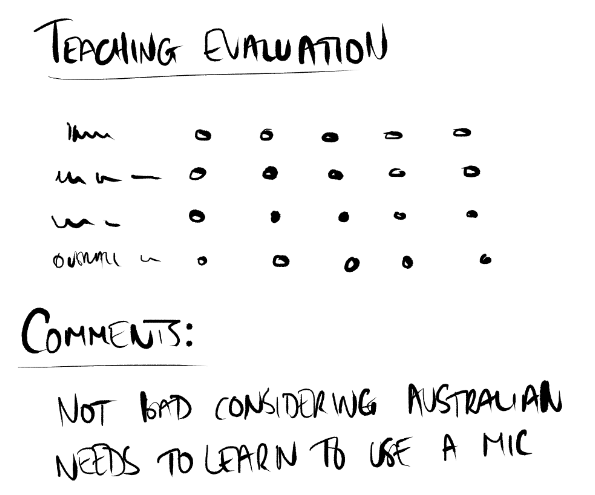
Feedback was mixed when it came to teaching evaluations. Apparently I have no idea how to use a mic, and some were quite unforgiving on mistakes in lecture notes. Still, feedback is an important part of development and I took all in my stride and tried to use it to improve my teaching.
Then I questioned why I should bother to wait for feedback through the class evaluations? I decided the best place for me to gauge my teaching was to pay attention to the class. I became quite adept at measuring the mood of the room based on the amount of chatter, heads on desks, eye rolling, etc. If I noted low energy as the lecture went on I would shake it up a bit. I had a few stories ready to tell for these occasions, or could throw up a cartoon. It would at least bring the class back to focus.
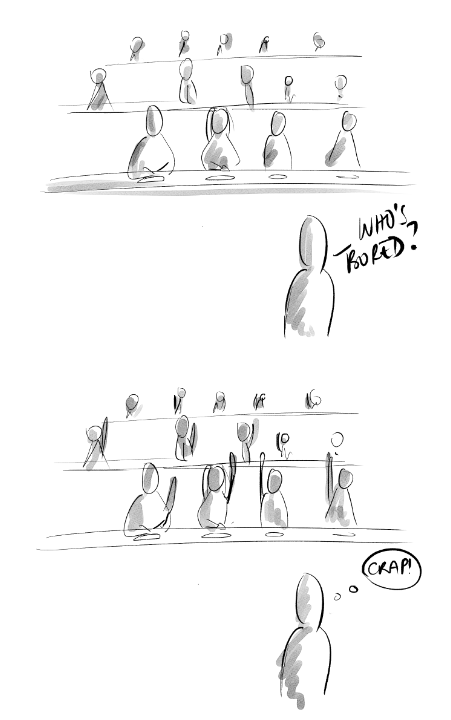
One time in my last year of teaching, I sensed the class was particularly bored towards the end of a lecture on functional group interconversions. I stopped the class and put myself on the spot by asking “Who’s bored?”. Kiwis will never lose an opportunity to stick it to an Aussie. About a quarter of the class eagerly put their hands up. Then I asked “Who doesn’t understand why we are learning all of this?” More hand went up! “Who wants to know why this is important?”. More hands! Now I had to respond.
I finished up that class by telling them its OK. That when I was a student I also struggled to understand why it’s important. I explained (again) that functional group intercoversion is the basis of all biochemical processes and therefore the basis of life.
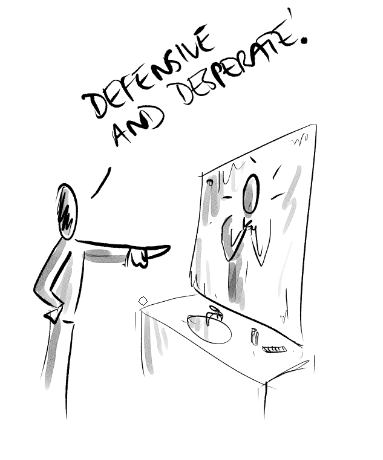
That evening, I beat myself up. I felt I probably came across as more defensive than inspiring. More desperate than convincing. The biochem angle was so cliche.
So the next day about an hour before my lecture I decided to talk about Tamiflu. At that time, the global supply chain was under threat due to the shortage of shikimic acid. The race was on for scalable synthetic routes from a variety of intermediates. SARS was still in peoples’ minds, so it had some relevance.
I didn’t have time to ChemDraw everything, so I had prepared a couple of transparencies of hand drawn routes to Tamiflu from different precursors. Each transformation was something we had learned in class. Ether formation. Epoxidation. Amine formation. Amide formation. There were issues stereoselectivity, and there were regioselectivity issues too.
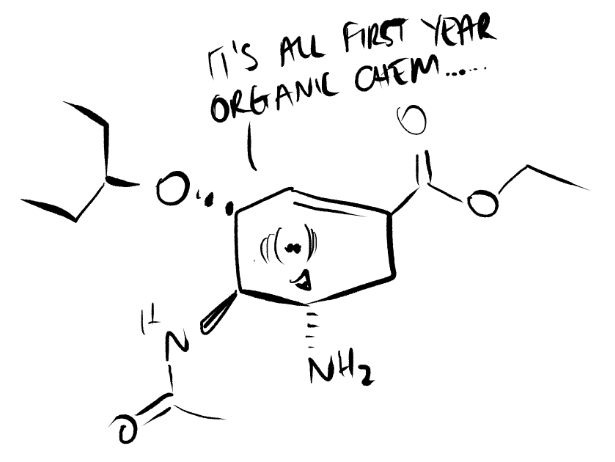
As I went through I reiterated that each of these transformations was basically the same first year organic chemistry the class had been learning. I left out the reagents. I was honest with the class – the reagents in textbooks are ideal. That to get to “textbook” status, there was a lot of failure on the way, and textbook chemistry rarely played out in the real word. I got the class to focus on the type of reactions. I asked them to think about the types of reagents. I asked them to reflect on the fact that what they were learning is done by researchers in labs trying to solve a global supply chain issue. I showed them the value of the work they were learning.
This lecture was a lot of fun. There was no lesson plan – I was basically free-styling the first half. The students were fully engaged. Even the sleepers up the back. I made up for my rather inadequate response on the previous day. In paying attention to the students in real time and putting some thought into how to show value, I achieved something I failed to do at the start of the course. If I hadn’t left academia, I would have started the course off with this approach from day one.
Why am I sharing this? Experienced teachers out there will be reading this saying “Duh?! I’m surprised you didn’t just do that in the first place”. Yep. I say that now too. But at one point it wasn’t obvious to me, so maybe someone will find this reflection useful. The most important learning from this for me was that you can’t teach value…you have to show it. This means that sometimes you have to ask if your students if they are bored.
 ChemScrapes
Leave a comment